




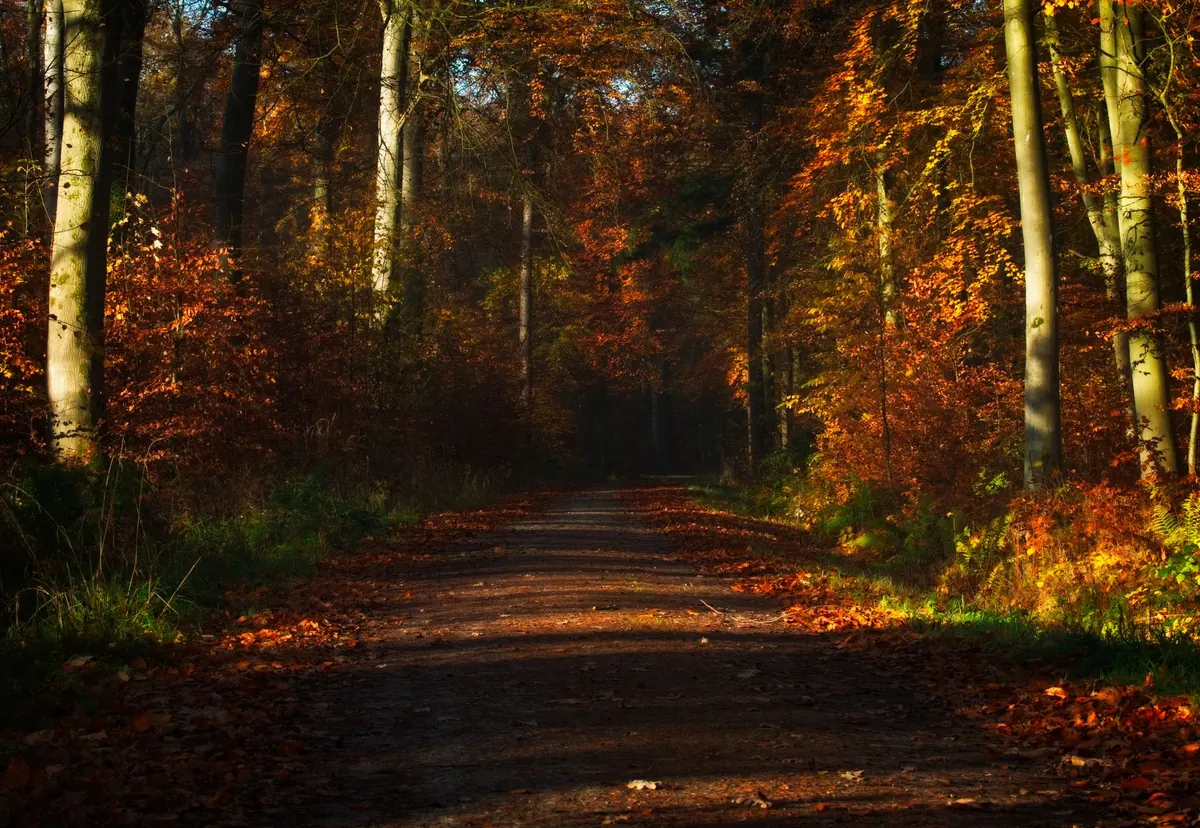
There is an hour on an October afternoon when the light turns amber, the air smells of wet bark and leaf mould, and a walk stops being exercise and starts being a gift. Autumn is generous and it is also leaving. The hedges hang heavy with hips and haws at the very moment the evenings start to draw in, and that tension — plenty, and the end of it — is what makes the season so good for gratitude.
What follows is a walk with a shape to it: three passes along the same route, then a short reckoning at the end. An hour, roughly. No app, no cushion, no journal unless you fancy one.
Why autumn does this better than any other season
Gratitude practices often fail because they stay abstract. "I am thankful for my health, my family, my home" — all true, all weightless by the third time you write it.
Autumn deals in concrete detail. A sweet chestnut husk under your boot. A jay crossing the lane with an acorn in its beak. The smell of a bonfire two fields away, drifting through a gap in the hedge. These are things attention can actually grip.
Season of mists and mellow fruitfulness — Keats, To Autumn
The phrase has lasted two centuries because it is accurate. Autumn supplies the senses rather than asking you to manufacture a feeling. It also supplies change, which is the raw material of gratitude: the same oak on the same path shows you something different every week. Watch a season turn and it becomes easier to notice what you have while you still have it.
Before you set off
- Pick a route you know. This is not a navigation exercise. A loop of forty to sixty minutes is ideal — a canal towpath, a footpath across two fields and through a small wood, a circuit of the local common.
- Go at the right hour. Late afternoon as the light drops, or early morning after rain. The middle of a bright day gives you flat light and a busy mind.
- Dress for wet ground. Boots with real grip, a waterproof, a spare layer. Wet leaves on tarmac and mud on a slope are the two places people slip.
- Leave a pocket free. One found thing — a conker, a beech leaf, a feather — carried home and put on a windowsill is worth more than a photograph. Take only what has already fallen, and leave fungi and flowers where they are, particularly on nature reserves.
The three passes
Walk the route once, but give each sense its own turn. You are not doing anything unusual; you are just refusing to let the hour blur.
First pass: sights
Let your eyes collect rather than scan. The undersides of beech leaves catching low sun. Sycamore keys hanging like small helicopters. A field of stubble holding mist. A spider's web strung between two fence posts, beaded with rain and worth more than most things on your phone. A kissing gate, a stile worn smooth by hands.
Set yourself a quiet target: five things on this route you have not noticed before. Describe each one to yourself in a sentence, as though you were telling someone about it later. That small act of translation is what fixes it in memory.
Second pass: sounds
Ask a question instead of trying to concentrate. What is the quietest sound I can hear right now? It is usually something: a leaf ticking against a branch, a robin's thin autumn song, water moving under a bridge, a woodpigeon somewhere behind you.
Then listen in layers — near, middle, far. Your own footsteps on gravel. A dog two fields over. Traffic, faint, on a road you cannot see. Layers teach perspective, which is a useful thing to remember when something in your life feels like the whole picture.
Third pass: smells and touch
Autumn smells are the ones that arrive with a memory attached, and they are everywhere if you handle things. Bruised mint along a footpath. Wet wool — your own coat. Cold at the tip of your nose. The rough bark of a sycamore, the soft rot of a log, a handful of pine needles rubbed between your fingers.
Touch does a particular job here. It pulls you out of your head and into your body, which is where gratitude actually lives rather than in the abstract part of your thinking.
The last ten minutes: turning noticing into gratitude
As you turn for home, or reach the gate where you started, stop. Lean on the gate. This is the part that makes it a practice rather than a nice hour out. Run through three questions:
- What did I notice today that I would have missed if I had been looking at my phone?
- What did the season give me that cost nothing?
- Who or what made this walk possible — the people who keep the footpath open, the dry hour between showers, the dog that made you leave the house, your own two working legs?
Be specific. "I am grateful for nature" is nothing. "The smell of poplar leaves along the canal, which I have not smelled since I was nine" is something you will still remember in February.
If it helps, write three lines before you get back into the car. Three lines is enough.
Making it stick as the days shorten
- Same route, same day, once a week. Ritual carries you when motivation does not.
- Lower the bar in November. Twenty minutes counts. A walk round the block in the dark, with one deliberate look at the sky, counts.
- Go out in the rain on purpose. Once. Dress properly and you will find there is a particular pleasure in being the only person outdoors.
Walking the same loop weekly shows you the change properly: the ash stripping back, the hedge going bare, the light leaving earlier each time. Watch that closely for a couple of months and something useful settles in — a sense of yourself as part of a season rather than stranded in one.
Your first walk this week
Choose a day, a route and a rough time, and put it in the diary as you would any other appointment. If you are walking somewhere remote or alone, tell someone where you are going and take a charged phone and a small torch; the light goes quickly now. If you have a health condition that affects walking, keep the route short and flat and take advice from your GP first.
Then go, and do not try to do it well. The aim is not a profound experience or a revelation in a beech wood. It is to spend an hour with your attention in the right place, and to come back with three specific things you are glad about. The first walk may feel like nothing much. By the fourth, you will start to notice the season working on you.
Photo: ArWeltAtty Attila / Pexels